

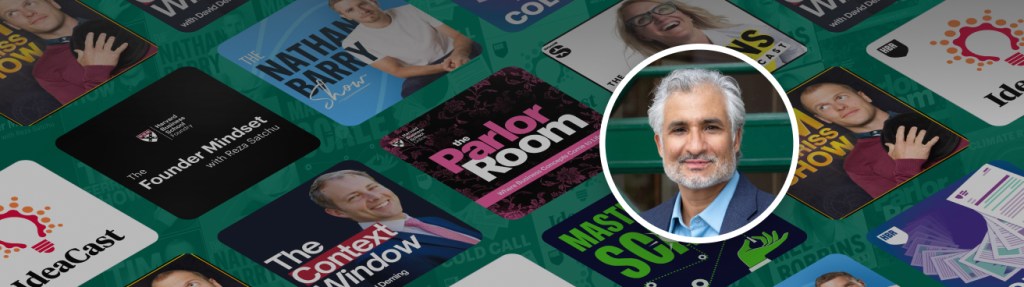
Reza Satchu is a business leader, serial founder, and educator whose work sits at the intersection of entrepreneurship, leadership, and decision-making under uncertainty. As a Senior Lecturer in the Entrepreneurship Management Unit at Harvard Business School, he teaches The Founder Mindset and Founder Launch—courses he created to help founders navigate ambiguity, make high-stakes commitments, and build enduring ventures.
Over more than two decades, Reza has co-founded, built, and scaled six businesses, with collective exits exceeding $3.5 billion. He is the Founder and Managing Partner of Alignvest Management Corporation, a private investment firm focused on long-term value creation. He also founded NEXT Canada, a national nonprofit that has supported over 1,200 entrepreneurs and helped launch more than 500 ventures.
Reza has been recognized with numerous honors, including the King Charles III Coronation Medal, Canada’s Top 40 Under 40 Award, the McGill University Distinguished Leader Award, the TiE Toronto Lifetime Achievement Award, and recognition as one of Canada’s Top 25 Immigrants. He holds a BA from McGill University and an MBA from Harvard Business School. His work challenges individuals to act decisively in the face of uncertainty and to view commitment not as a constraint, but as a powerful driver of extraordinary outcomes.
Every founder story gets told backwards. By the time you hear it the outcome is known, the risk has resolved itself, and the person telling it sounds like they saw it coming. They didn’t.
I’ve spent twenty-five years on both sides of that gap, building companies, and then teaching the people who want to build their own. Judgment isn’t formed in the retelling. It’s formed in the moment you have to act without knowing whether you’re right.
These are ten shows that get close to that moment. Some are founder interviews, some are case studies, and a couple aren’t about business at all. What they have in common is a willingness to sit inside the uncertainty instead of skipping past it.
The Founder Mindset with Reza Satchu
I’ll get the self-serving pick out of the way first. I started this show because most business podcasts ask founders to narrate their success stories, and I’m not interested in that. I want to hear about the decision that terrified them, the moment they had to commit without knowing if they were right. Reese Witherspoon, Tim Ferriss, Alix Earle, Kevin O’Leary. Same question every time: what did you actually do, before you knew it would work?
The Tim Ferriss Show
The reason Tim has lasted isn’t the guest list, impressive as it is. It’s that he asks the unglamorous follow-up — what specifically did you do, at what hour, with what tool — and keeps asking until the answer is something you could actually copy. A decade and change into it, he has assembled the largest first-hand library of how high performers make decisions. Very few interviewers are willing to be that literal.
The Nathan Barry Show
Nathan built Kit from a side project into the email platform behind tens of thousands of creator businesses, and his show does something unusual: he coaches guests live rather than interviewing them. You hear a real business get taken apart and put back together — pricing, positioning, the thing the founder has been avoiding. It is the closest thing in podcast form to the conversations I have in office hours, and just as uncomfortable.
Masters of Scale
If The Founder Mindset is about the decision before the outcome, Masters of Scale is about the far less romantic problem that follows: you have something that works, and now it has to work at a hundred times the size. Reid Hoffman and his co-hosts get operators to be specific about the structural questions — when to hire ahead of demand, which of your own rules to break, what to stop doing. Different stage, same discipline.
Cold Call
This is the case method in audio form. Brian Kenny sits down with HBS faculty to walk through cases they’ve written, and the format does exactly what I want a classroom to do: it puts you in the protagonist’s chair with incomplete information and asks what you would do. If you’ve never sat through a case discussion, this is the cheapest way to find out whether you enjoy thinking that way. Most founders do.
Harvard Business Review IdeaCast
IdeaCast is where I go for the evidence layer. Founder intuition is real and it matters, but it gets sharper when you know what the research actually says about hiring, negotiation, incentives, and org design. The hosts get academics to state plainly what they found and why it should change your behaviour, usually in under half an hour. It’s the most efficient management education available for free.
The Context Window with David Deming
David is an economist who studies how careers actually get built, and his show is about the part nobody puts in a bio: the detours, the doubt, the stretch that looked like nothing at the time. I recommend this one to students constantly, because almost every ambitious young person I teach is privately convinced they are behind schedule. They aren’t, and this is the evidence.
The Mel Robbins Podcast
Founders talk endlessly about market risk and almost never about the thing actually holding them back, which is usually internal. Mel Robbins works on that directly — the self-imposed limits, the need for approval, the habit of waiting for permission that nobody is coming to grant. The Let Them Theory is the best-known example and it is far more useful to an operator than the title suggests. She is also an exceptional communicator, which is a lesson on its own.
The Parlor Room presents: Hello AI
Every founder I know is currently placing bets on a technology none of us fully understands. Hello AI is a compilation from HBS Online’s The Parlor Room in which Chris Linnane puts the blunt version of the question — is AI going to take your job — to faculty including Joe Fuller, Christina Wallace, Iavor Bojinov, and Nien-hê Hsieh. No hype, no doom. Just people who study labour markets and technology adoption reasoning it through out loud.
Climate Rising
Climate is the longest-horizon uncertainty in business: decisions made now, consequences measured in decades, and almost no clean feedback loop in between. Mike Toffel talks to the executives and investors making those calls anyway — what they are actually doing, what it costs them, what is working. Whatever you make of the politics, the operating problem is real, and this is the most practical show I’ve found on it.