

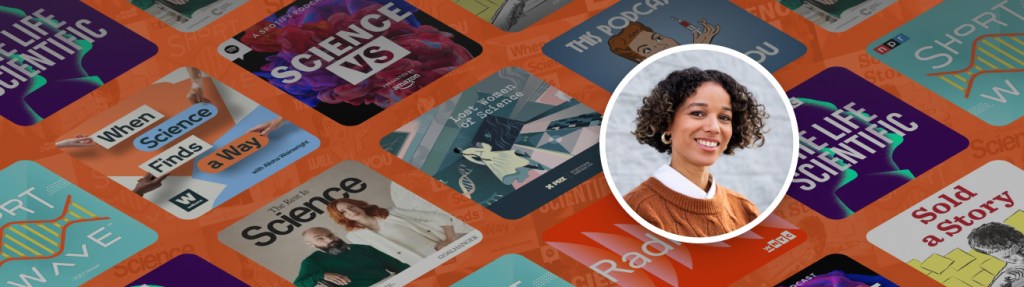
Alisha Wainwright is an actress, science communicator and the host of When Science Finds A Way – a podcast where she speaks with scientists, innovators and diverse communities. Her mission is to build trust in science by listening to diverse voices and telling stories that connect science to people’s everyday experiences.
In her opinion, science is not just about discoveries – it is about people asking questions, testing ideas, and working together to improve lives.
She loves science podcasts that take listeners behind the scenes of research, combine rich storytelling with a strong evidence-based approach and help make science more understandable, trustworthy, and relatable.
I studied botany before becoming an actor, and science has always been one of the ways I make sense of the world. What I love most is that science is not just about discoveries. It is about people asking questions, testing ideas, and working together to improve lives.
Hosting When Science Finds a Way has given me the chance to reconnect with that part of myself. I get to speak with scientists, innovators, and communities all over the world, and I’m constantly reminded that building trust in science starts with listening to diverse voices and telling stories that connect evidence to people’s everyday experiences.
When I’m looking for a science podcast, I’m drawn to shows that feature scientists as hosts or guests and take listeners behind the scenes of research. I love podcasts that combine rich storytelling with a strong evidence-based approach, helping make science more understandable, trustworthy, and relatable.
These are some of the podcasts I return to when I want to learn something new, challenge my assumptions, and be reminded of how fascinating and deeply human science can be.
The Life Scientific
Hosted by Jim Al-Khalili, this podcast offers thoughtful conversations with leading scientists about their lives and work. I love hearing what inspired them, the obstacles they faced, and the moments that changed the course of their research. It is a wonderful reminder that science is driven by curiosity, persistence, and very human stories.
Science Vs
Hosted by Wendy Zukerman, this is one of my favorite podcasts for tackling the topics everyone is talking about and asking what the evidence actually says. There are so many strong opinions, trends, and headlines competing for our attention, especially when it comes to health and science. I love that Science Vs does the hard work of sifting through the research so listeners can understand what is fact, what is not, and what lies somewhere in between. It is rigorous, funny, and incredibly accessible.
Radiolab
Hosted by Lulu Miller and Latif Nasser, Radiolab is one of my all-time favorites. Each episode begins with a big question and follows it through science, history, and personal stories, all with incredibly inventive sound design. I always come away seeing familiar ideas in a completely new way.
Sold a Story
Hosted by Emily Hanford, I love this podcast because it does such a brilliant job of explaining the science of how children learn to read through phonics-based instruction. What I found especially compelling is how it shows that even well-established research can be undermined by politics, bureaucracy, and commercial interests. For me, it is a powerful reminder that scientific evidence alone is not enough. We also have to think about how that evidence is communicated and implemented in the real world.
Short Wave
Hosted by NPR science journalists including Emily Kwong, this is my go-to when I want to learn something new in a short amount of time. The episodes are concise, engaging, and always grounded in the latest research. It is perfect for satisfying my curiosity in just a few minutes.
The Rest Is Science
Hosted by mathematician and broadcaster Hannah Fry and science creator Michael Stevens, this podcast takes big scientific ideas and connects them to everyday life, whether they are exploring nutrition, household technology, or some of the stranger questions about how the world works. I especially love Hannah Fry’s work on artificial intelligence and how emerging technologies can shape society. This season of When Science Finds a Way explores the growing role of AI in mental healthcare, so I have been fascinated by the conversations happening around this topic. What I appreciate most about The Rest Is Science is that it makes complex ideas feel relatable and grounded in real life, which is something I care deeply about in science communication too.
This Podcast Will Kill You
Hosted by Erin Welsh and Erin Allmann Updyke, this show explores diseases through biology, history, and culture. I recently found their episodes on dietary guidelines especially interesting. On When Science Finds a Way, we have been looking at the connections between diet and mental health, as well as supermarket trials designed to help people make healthier choices. I love how this podcast combines rigorous science with historical context and thoughtful discussion, helping listeners understand not just what we know, but how scientific evidence is shaped and applied.
Lost Women of Science
Hosted by Katie Hafner, this podcast shines a light on the many women whose scientific contributions have gone unrecognized over the years. There is so much more to the history of science than the handful of names most of us learn in school. I first discovered it while researching our episode on tranexamic acid, postpartum hemorrhage, and the pioneering work of Dr. Utako Okamoto, and I was immediately hooked.
Science has always filled me with a sense of wonder. These podcasts capture that beautifully, while also showing that the most meaningful discoveries happen when evidence, storytelling, and human experience come together.